MECE Analysis
Sep 7, 2025
·
1 min read
 MECE Analysis in Nodlin
MECE (Mutually Exclusive, Collectively Exhaustive) is a structured framework developed by Barbara Minto at McKinsey & Company for decomposing complex problems into clear, non-overlapping categories that together cover the entire problem space.
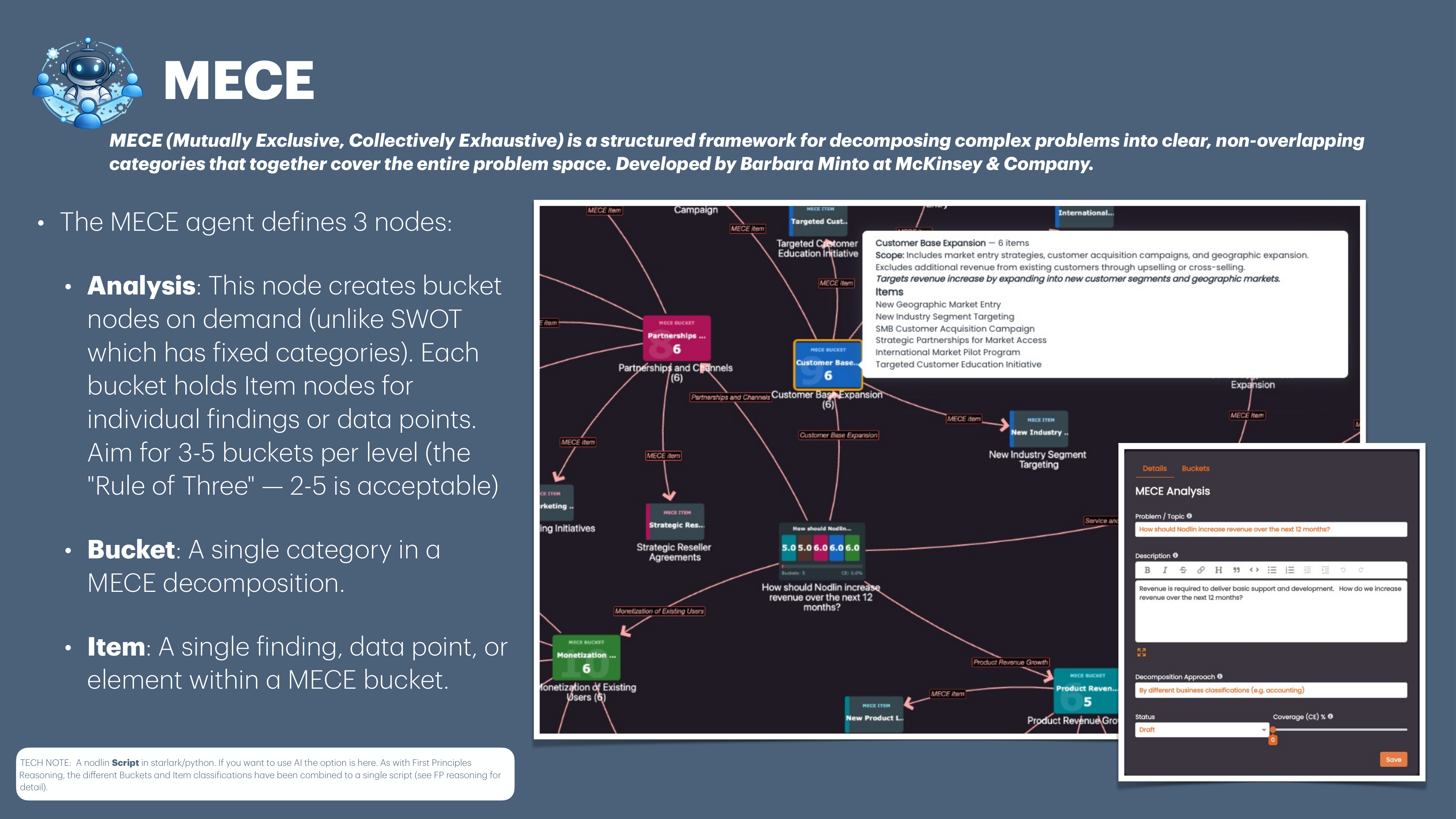
The agent defines three node types:
- Analysis 📋 — Top-level container that creates bucket nodes on demand. Aim for 3–5 buckets per level (the “Rule of Three” — 2–5 is acceptable)
- Bucket 📁 — A single category in a MECE decomposition
- Item 📝 — A single finding, data point, or element within a bucket
How It Works
- Create an Analysis and describe the problem to decompose
- Add Buckets — each must be mutually exclusive (no overlap) and collectively exhaustive (full coverage)
- Populate Items within each Bucket for individual findings or data points
- Refine the structure — split or merge buckets as understanding deepens
- AI assistance can suggest initial decomposition categories
Benefits
- Structured Thinking 🧩 — Prevents gaps and overlaps in analysis
- Scalable Decomposition 📐 — Nest buckets for multi-level breakdowns
- Consulting-Grade Rigour 🏢 — Industry-standard approach used at leading firms
- Collaborative 🤝 — Teams can work on different buckets simultaneously
