OKR (Objectives & Key Results)
Sep 7, 2025
·
1 min read
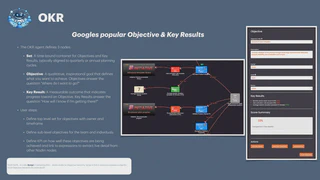 OKR in Nodlin
OKR (Objectives and Key Results) is a goal-setting framework popularised by Google for aligning teams around qualitative goals and measurable outcomes. It answers two questions: “Where do I want to go?” (Objective) and “How will I know if I’m getting there?” (Key Result).
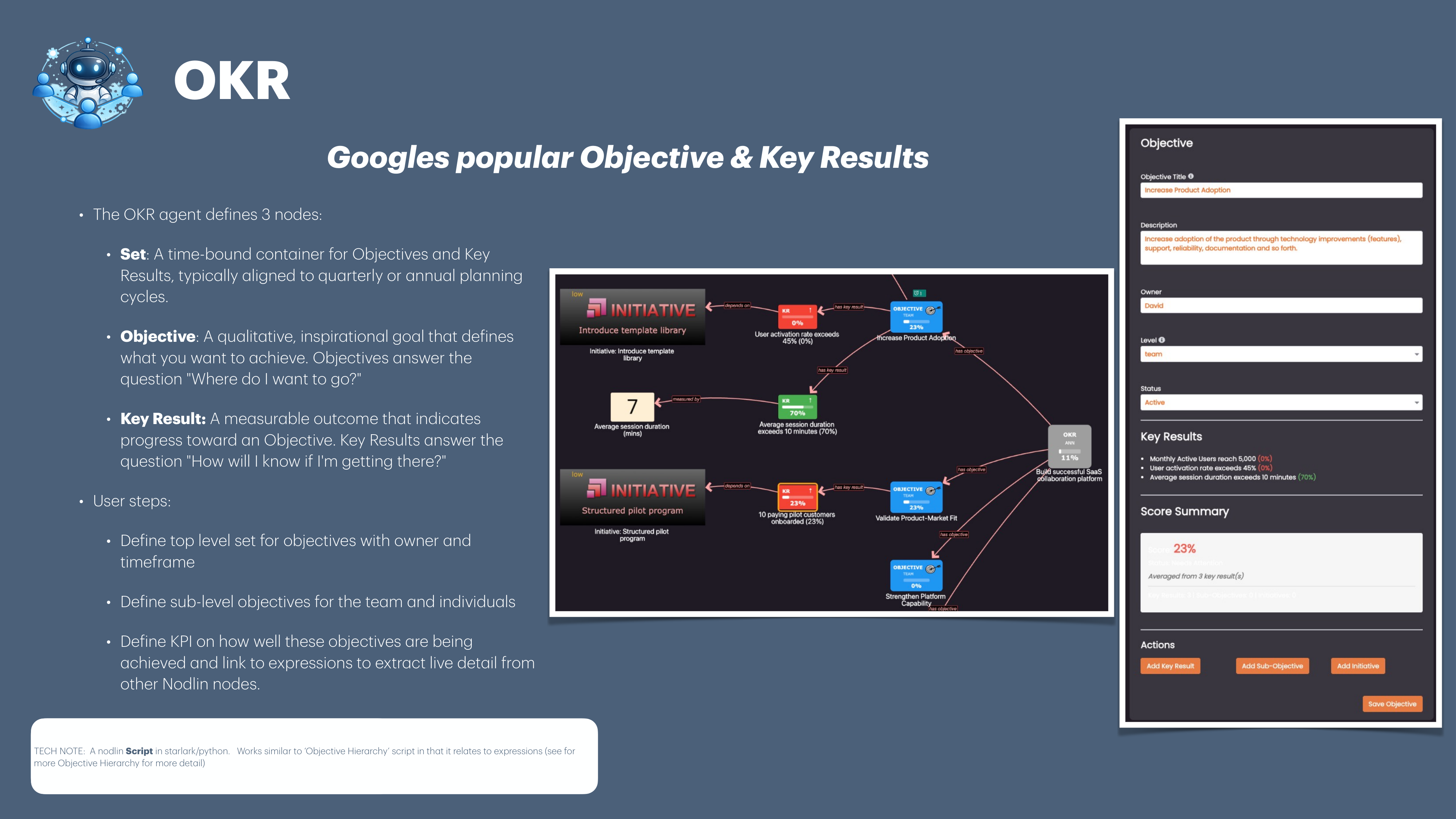
The OKR agent defines three node types:
- Set 📋 — A time-bound container for Objectives and Key Results, typically aligned to quarterly or annual planning cycles.
- Objective 🎯 — A qualitative, inspirational goal that defines what you want to achieve.
- Key Result 📊 — A measurable outcome that indicates progress toward an Objective.
How It Works
- Define a top-level Set with an owner and timeframe
- Create sub-level Objectives for teams and individuals
- Attach Key Results with measurable targets
- Link KPIs to expressions that extract live detail from other Nodlin nodes for real-time tracking
Benefits
- Alignment 🔗 — Cascading objectives connect individual work to organisational strategy
- Transparency 🔎 — Everyone can see how their work contributes to broader goals
- Focus 🎯 — Limits the number of priorities to drive meaningful progress
- Real-time Insight ⚡ — Expressions link to live data across your Nodlin for up-to-date KPI tracking
